
One unit is one message
A unit is one message of one channel and product type: an SMS part, a WhatsApp message, an RCS message, a call minute. Units are kept separately for each channel and product type, such as SMS Transactional, SMS Promotional or WhatsApp Marketing. Units of one kind can’t be used for another. A unit works for any country the account is allowed to send to.Who holds what
- A reseller
- A sub-reseller
- A customer
FireFlo gives a reseller money (its wallet and pockets) and a price list. The reseller
sets no prices and no markup. It gives units to the customers directly below it.Units you can still give, per channel and product type, is worked out from the
money that pays for that channel, less what the units already given out would cost,
divided by the reseller’s own price in its home country. Giving more than that is
refused. Giving units moves no money: each message is charged to the reseller when it
is sent.What the reseller charges its customers for units is between them.
When a message is sent
- It uses one unit of its channel and product type from the account that sent it. A long SMS uses one unit per part, and a call one per started minute.
- It is charged to the top reseller, the one FireFlo gave money to, at that reseller’s price for the recipient’s country. The sender’s wallet doesn’t move, and nor does a sub-reseller’s.
- A message the channel refuses gives its unit back, and the money where it was charged.
When something runs out
- No units of a kind: that account’s sends of that kind are refused, with the units
held and needed, and words that name the type and who gives the units, such as No
RCS Rich card, carousel or media units left. Ask Northwind for more. The refusal code
is
no_unitson every channel. A broadcast pauses and carries on by itself when units arrive, on SMS too. Other kinds carry on. - A kind with no price: a message type that has no price for the reseller needs no units and is free below the reseller.
- The reseller’s money runs out: sends on that channel pause for every account below it, whatever units they hold. They carry on when money arrives.
- The reseller’s money no longer covers the units given out: its Customers page warns it. Nothing is taken back.
Prices never change units
Units are message counts. When FireFlo changes a reseller’s price, every unit balance below it stays as it is. Only what each later message costs the reseller changes.SMS below a reseller
Each SMS an account below a reseller sends is charged to its reseller, at the reseller’s price, on FireFlo’s SMS gateway. Counted at the gateway. On a gateway at 0.16.0 or newer, the account’s SMS units are held and counted at the gateway itself, one unit per message part. Sends from OMNI, over the API and over the account’s own SMPP login are all counted in the same place, as they are sent. Billing shows the gateway’s figures and when they were read. With no units of an SMS type left, a send is refused with a message such as No Transactional units left. Ask Northwind for more., naming the SMS type and your provider, and nothing is charged; over SMPP the login is answered status0x403. Sending carries on as soon as units arrive: the
login stays the same.
When SMS units run low, the account’s people and its provider’s are emailed, and again at
zero.
On an older gateway, units are counted in OMNI. An account may also send SMS straight
to the gateway over its own SMPP login. That login is switched off when the units of
the kind it sends run out. SMS sent over the login is counted from the gateway’s records
shortly after it is sent, so a few messages sent just before the login is switched off can
take the balance below zero; they are still charged to the reseller. When new units
arrive, a new login is made, with a new system ID. Its password has to be reset before
it can be used: ask your provider.
Unit history
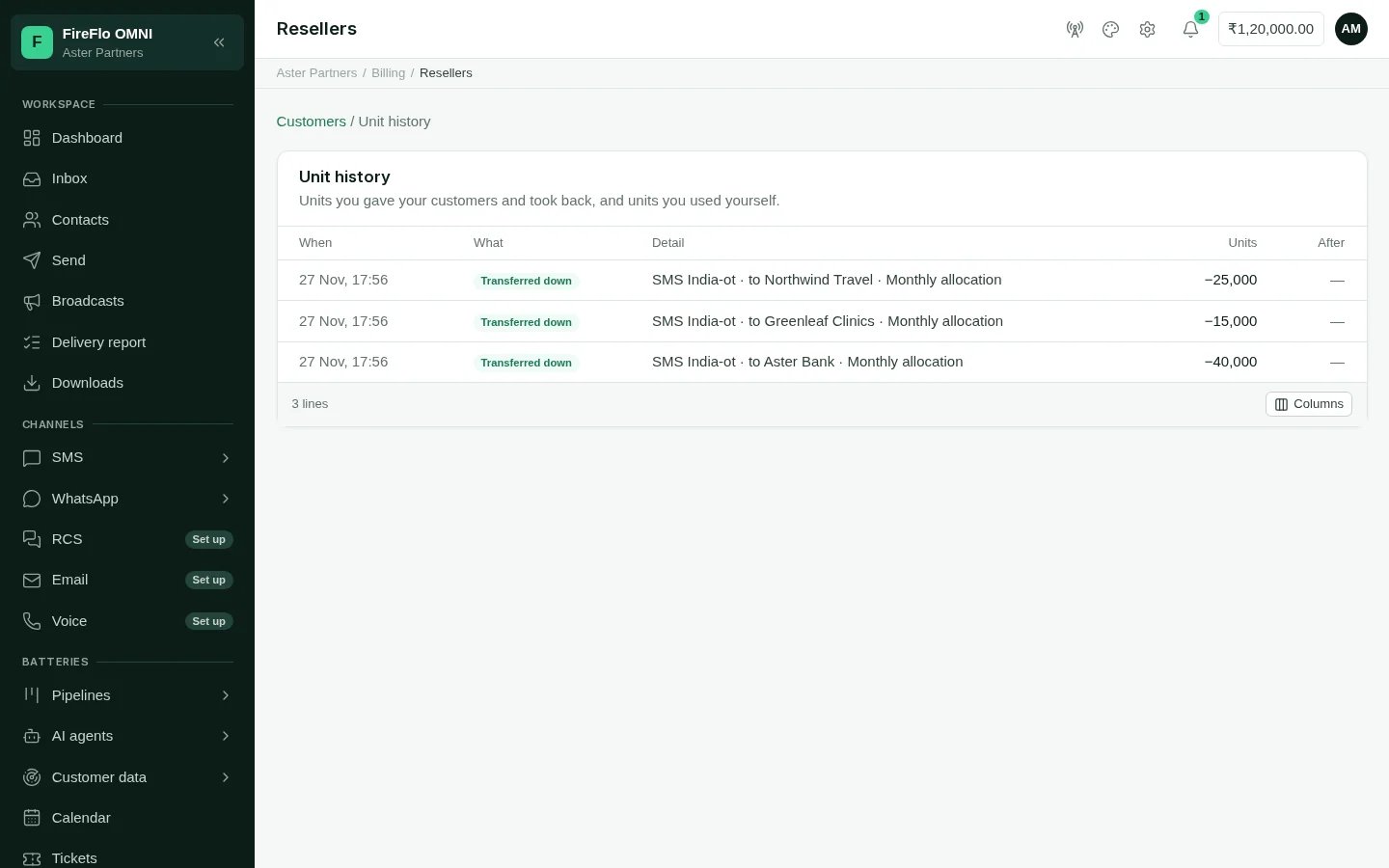
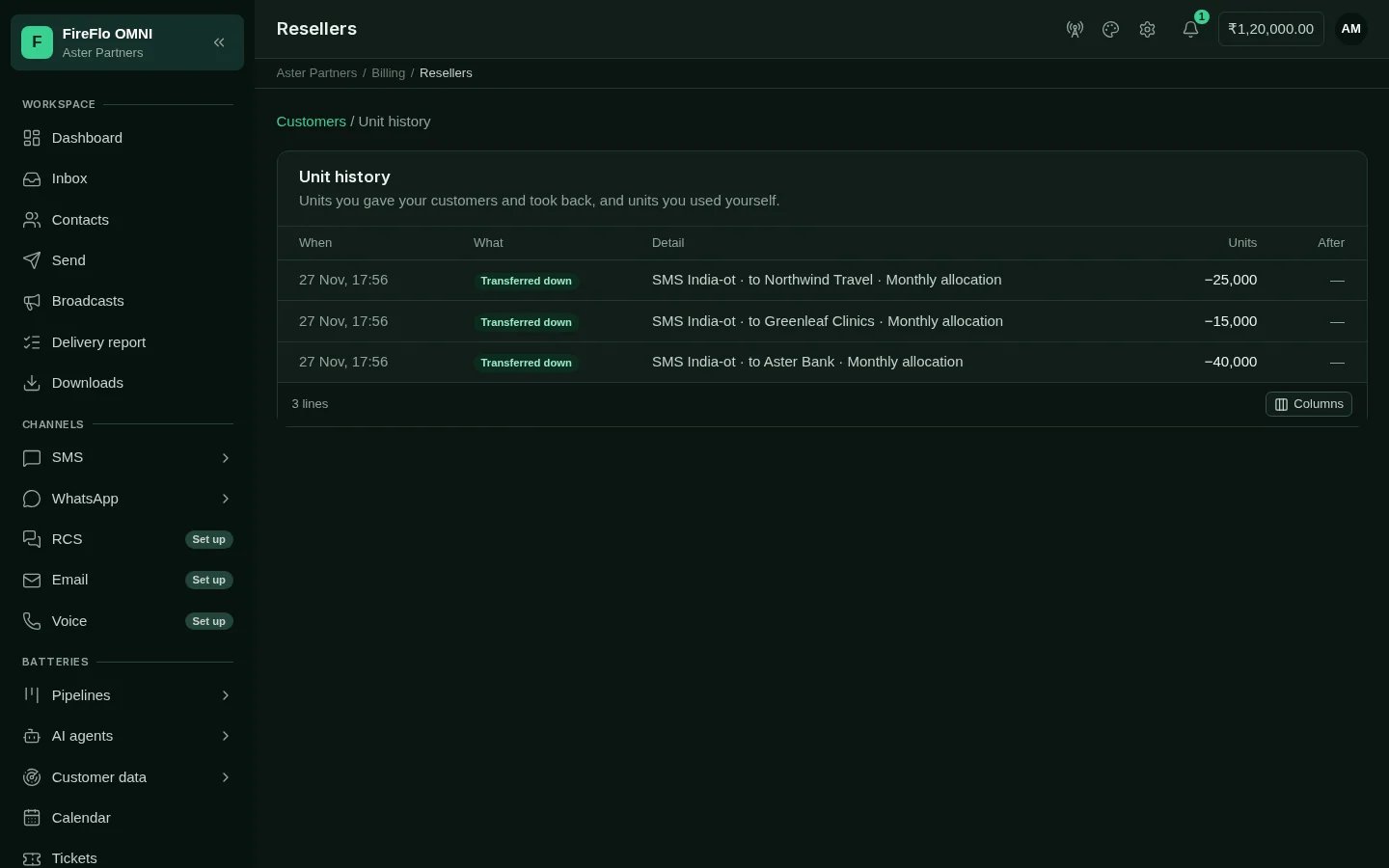
Unit history: every movement of units, such as each customer's monthly allocation.
Resellers see it under Unit history on Billing → Resellers, and
for each customer on its Units tab. A customer sees its own under Billing → Unit history.